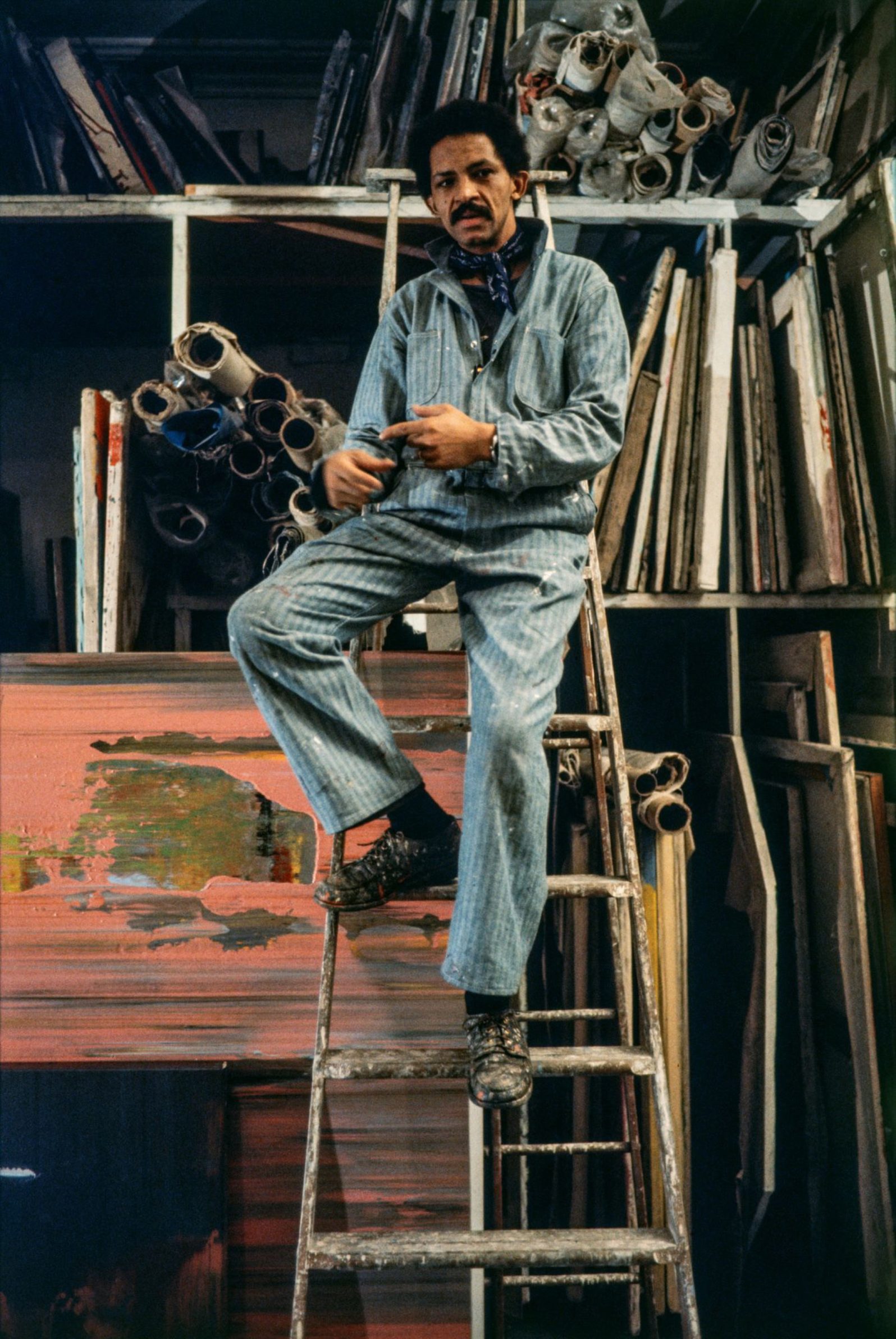
At the age of 74, Whitten completed the largest painting he would ever make: Atopolis. In his own writings, Whitten describes Atopolis as a potent idea for members of the African diaspora, a vision of a city formed not by territory but by movement, memory and multiplicity. Today, this monumental canvas belongs to MoMA’s permanent collection and forms the centrepiece of ‘Jack Whitten: The Messenger’, a revelatory exhibition tracing the artist’s engagement with race, technology, jazz, love and war.
Personal memories
The sliding doors of The Steven and Alexandra Cohen Center for Special Exhibitions on the sixth floor of MoMA open with quiet precision on 18 March. As visitors move past me into ‘Jack Whitten: The Messenger’, my pace slows. Once inside, emotion rises — filling my chest, catching in my throat, stinging behind my eyes. The buzzing preview crowd dissolves into the background. I catch myself thinking how Whitten would have loved this moment. He would have savoured the conversations, the energy, the way his work now connects across generations.
Jack Whitten passed away in early 2018, yet here his spirit still feels unmistakably near. Jazz floats through the galleries, his voice resounds in audio recordings; the works feels charged with energy. Over 175 pieces have been assembled here, from his earliest experiments in the 1960s to his final, radiant painting, Quantum Wall VIII (For Arshile Gorky, My First Love in Painting), completed in 2017.
This exhibition touches me on many levels. From 2011 onward, I worked closely with Jack during my years at Zeno X Gallery in Antwerp and visited his studio and home multiple times. What I experience in this retrospective is not just institutional recognition, but something more personal: a celebration of a lifetime of conviction. Jack painted through doubt, through financial hardship, through periods of neglect. He believed in the long arc. And today, his work is receiving the attention it deserves.
It reminds me how proximity matters. Knowing Jack, hearing his voice, visiting his studio — these experiences influenced the way I process the work and the exhibition. But proximity isn’t just physical. It can also be a mode of attention. Today, we often expect art to speak to us instantly. But Whitten’s work invites slowness and attention. It asks for resonance, for time, for openness. Do we still allow ourselves to be open to that kind of encounter? To move beyond consuming images and actually be impacted by them? To dwell in uncertainty, complexity, wonder?
‘The Messenger’, curated by Michelle Kuo, offers that space. It is not a classic retrospective, but rather a moment of transmission. A chance to listen closely. And to receive, if we’re open to it, the quiet but insistent frequencies of matter.
From Artforum to MoMA
Michelle Kuo’s relationship with Jack Whitten begins around 2010, when she first encounters a group of works he completed following a residency at the Xerox Corporation in 1974. ‘They looked like radar scans or electron microscope images,’ she told me during a conversation we had last March. ‘But it turned out they were all made by hand.’
That moment marked the beginning of a deeper engagement. As editor-in-chief of Artforum, Kuo published a portfolio of artworks by the artist in 2012 and placed one of Whitten’s paintings on the magazine’s cover. It’s safe to say that most readers weren’t familiar with Whitten’s work at the time.
On that same cover was a headline referencing ‘New Work by Gerhard Richter.’ The juxtaposition was not necessarily intended to put the two artists’ work in direct dialogue, but it did creat a moment of visual confusion and critical reflection. ‘It wasn’t a statement,’ she clarified, ‘but more of an exploration — of how, across time and distance, artists can arrive at parallel innovations. They both were confronting some of the most tumultuous times in recent history. On the one hand, the aftermath of World War II, on the other, the aftermath of slavery and segregation in the US, the Cold War and the intense effects of technological transformations on society as well. So both Richter and Whitten are not afraid to confront the biggest issues facing humans, and to research the possibilities of contemporary painting. While Richter is more about oil painting and Whitten related to acrylic painting, both artists have something to say about photography and the impact of photography in relation to painting.’
Appointed as Chief Curator at Large and Publisher at MoMA in 2024, Kuo brings that same curiosity and intellectual depth to ‘The Messenger’, which is the most comprehensive presentation of Whitten’s work to date. Her approach is not only historical but also spatial: she carefully structured the exhibition’s rhythm around the shifts in Whitten’s practice. Some galleries span decades; others slow time entirely to delve deeply into a particular period.
It was important for Kuo to show that his innovations weren’t occasional, but constant. ‘He didn’t just evolve over time. He exploded and reassembled the language of painting again and again.’
Unlike many celebrated painters who establish a recognisable visual identity early on, Whitten refused stylistic consistency. ‘He was relentlessly shapeshifting,’ she said. ‘And that went against the grain of what’s often rewarded — by the market, by institutions, even by art history.’ Whitten developed at least ten radically different working methods, from dragging paint across the canvas to making acrylic reliefs, from Xerox-inspired drawings to mosaic constructions, all while working largely outside the art world spotlight.
A central axis of Kuo’s curatorial vision for the exhibition is Whitten’s use of acrylic paint — not simply as a medium, but as an evolving technology. He stretched its material logic far beyond the flatness of the canvas, slowing its drying time with chemicals, embedding it with graphite, pouring it into slabs of paint, casting it into ‘ready-nows’ or slicing it into tesserae. By the 1990s, he had achieved what Kuo calls ‘the marriage of the ancient and the futuristic’, paintings that somehow resemble both Byzantine mosaics and digital screens. At first glance they look like they could be made of ceramic or glass, but it’s pure paint. At the same time, they evoke pixelated images, built from tiny constituent bits.
What makes Whitten’s work urgent today, in Kuo’s view, is not only its material inventiveness but its relation to art history, the history of painting, technology, memory, race, war, diaspora and metaphysics.
Born in Bessemer
History often pivots on something small: a dinner, a drink, a passing remark. For Jack Whitten, it was a lunch. In 2010, Joel Wachs (president of the Andy Warhol Foundation) and Frank Demaegd (founder of Zeno X Gallery) sit down at the Cookshop in New York. Wachs describes a painting he has just seen in the viewing room at Alexander Gray Associates, the gallery that represents Whitten at the time. Driven by curiosity, Frank visits the gallery to see that painting. On his way back to the airport to return to Belgium, he stops by Whitten’s studio to meet the artist.
In March 2011, Jack Whitten opens his first solo show in Belgium at Zeno X Gallery. Two more would follow, in 2012 and 2015. This moment marked a shift for Whitten — not just in terms of visibility, but in momentum. Whitten’s work begins circulating more on the international art market, and Zeno X, together with Alexander Gray Associates and later Hauser & Wirth, play a key role in establishing his market presence.
Through gallery shows and international fairs, Zeno X placed Whitten’s works in the collections of Tate Modern (London), SFMOMA (San Francisco), MoMA (New York) and the Walker Art Center (Minneapolis), among others. Belgium became part of the story, and for the first time, Whitten could feel that the world was truly looking.
Whitten wrote in his journal in 2012:
‘Lot’s to do: talk in Boston, talk in Amsterdam + show at Zeno X plus all the fairs with Zeno X. For the first time I am not worried about money …’ (Notes from the Woodshed, 212, September 10, 2012, p. 397)
In 2014 work by Jack Whitten was displayed at the 4th Biennial of Painting at Museum Dhondt-Dhaenens (Deurle, Belgium), curated by Tanguy Eeckhout (1980–2018) and Joost Declercq. A year later, the exhibtion Atopolis follows in Mons, located in the South of Belgium.
How a Lunch at Cookshop Changed the Life of Jack Whitten
History often pivots on something small: a dinner, a drink, a passing remark. For Jack Whitten, it was a lunch. In 2010, Joel Wachs (president of the Andy Warhol Foundation) and Frank Demaegd (founder of Zeno X Gallery) sit down at the Cookshop in New York. Wachs describes a painting he has just seen in the viewing room at Alexander Gray Associates, the gallery that represents Whitten at the time. Driven by curiosity, Frank visits the gallery to see that painting. On his way back to the airport to return to Belgium, he stops by Whitten’s studio to meet the artist.
In March 2011, Jack Whitten opens his first solo show in Belgium at Zeno X Gallery. Two more would follow, in 2012 and 2015. This moment marked a shift for Whitten — not just in terms of visibility, but in momentum. Whitten’s work begins circulating more on the international art market, and Zeno X, together with Alexander Gray Associates and later Hauser & Wirth, play a key role in establishing his market presence.
Through gallery shows and international fairs, Zeno X placed Whitten’s works in the collections of Tate Modern (London), SFMOMA (San Francisco), MoMA (New York) and the Walker Art Center (Minneapolis), among others. Belgium became part of the story, and for the first time, Whitten could feel that the world was truly looking.
Whitten wrote in his journal in 2012:
‘Lot’s to do: talk in Boston, talk in Amsterdam + show at Zeno X plus all the fairs with Zeno X. For the first time I am not worried about money …’ (Notes from the Woodshed, 212, September 10, 2012, p. 397)
In 2014 work by Jack Whitten was displayed at the 4th Biennial of Painting at Museum Dhondt-Dhaenens (Deurle, Belgium), curated by Tanguy Eeckhout (1980–2018) and Joost Declercq. A year later, the exhibtion Atopolis follows in Mons, located in the South of Belgium.
Whitten – Warhol
Meanwhile, Joel Wachs remained quietly on the lookout for a Whitten painting for his own collection. The work needed to resonate personally, be appropriate for his own space and speak to him on an artistic level. Reading the Artforum feature on Whitten in 2012, he came across Birmingham 1964. A part of the painting depicts a Civil Rights-era image of a teenager being attacked by a police dog — imagery also used in a work by Andy Warhol. Wachs was set on acquiring the piece.
At first, Whitten hesitated to sell it. The painting carried painful memories related to the American South and the racism he had experienced first-hand there. But when Alexander Gray explained that it was Joel Wachs who introduced Frank Demaegd to his work, Whitten agreed to let the painting go. That work has since been exhibited many times, and is now on view at MoMA.
Atopolis: Made for Mons, Belonging Everywhere
Atopolis is one of the most ambitious articulations of Jack Whitten’s thinking around space, memory and diaspora. Monumental in scale and scope, this eight-panel painting — measuring over six by three metres — is composed of thousands of hand-cut tesserae, infused with metallic and phosphorescent pigments. It resembles a satellite image or a galactic map: fragmented, luminous and unlocatable. The painting’s black base tone reflects a conscious gesture, referencing coal, Blackness, ancestral and material memory.
The painting was created for the group exhibition Atopolis, curated by Dirk Snauwaert (artistic director of Wiels in Brussels) and Charlotte Friling, and presented in Mons in 2015 as part of ‘Mons 2015 – European Capital of Culture’. The exhibition was staged in the Site du Manège, a former industrial site in the Borinage region that has been historically shaped by the coal mining industry. For Whitten, whose father had worked in the mines of Alabama, the invitation carried profound personal significance.
The title Atopolis (from the Greek a-topos, or ‘no-place’) became a conceptual framework for the painting. Whitten saw it as a response to the sense of placelessness experienced by the African diaspora — dislocated by slavery, colonialism and modernity. It was also a philosophical reference to Édouard Glissant, the Martinican writer and theorist with whom Whitten shared a deep concern for relation, opacity and displacement. When Snauwaert recommended Poetics of Relation to Whitten, Whitten recalled having already met Glissant through his friend Melvin Edwards. The English translation opened up what Whitten experienced as a striking resonance between his own artistic thinking and Glissant’s poetic theory.
‘My painting Atopolis: For Édouard Glissant is an anthracite color structure juxtaposed within a blunt contrast of pure aluminum pigment,’ Whitten wrote. ‘It is built to absorb the surrounding natural light, and redirect it outwards in order to create a dynamic multi-dimensional space’ (note by Jack Whitten to Dirk Snauwaert, April 2015).
In 2015, Yasmil Raymond, then Associate Curator at MoMA, travelled to Mons to visit the exhibition. She recognised the importance of the painting Atopolis and brought it to the attention of the museum’s acquisition committee. With the support of Zeno X Gallery, who facilitated the acquisition, the work entered MoMA’s permanent collection. It now features prominently in ‘The Messenger’, not only as one of Whitten’s masterpieces, but as a testament to the transatlantic networks of thought, experience and artistic exchange that brought it here.