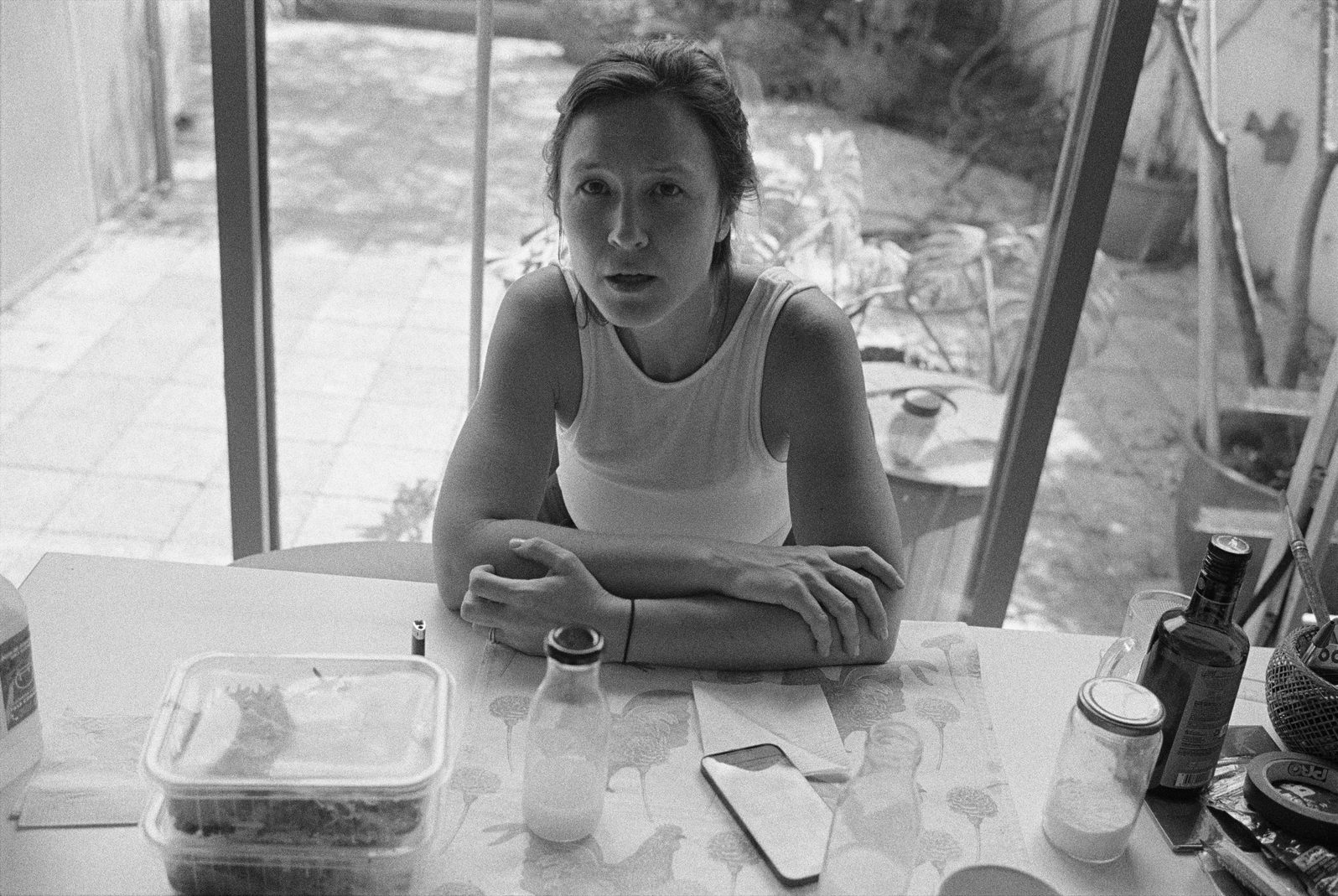
To approach a painting by Marina Rheingantz is like stepping into an atmosphere. Her canvases, textiles and works on paper unfold as open fields rather than as scenes or situations. They invite an experience of being rather than explaining. What resonates for this artist is not a narrative, but a presence; not a statement, but a sensation. At ICA Milano, ‘Rodamoinho (Whirlwind)’ gathers new paintings and textile works created after the birth of her first child. She describes motherhood as an expansive experience in which her personal and artistic life alternately evolve at high speed. This institutional exhibiiton materialises her appreciation for monumental scale, freedom and interior space.
A First impression
I first encountered Rheingantz’s paintings in Miami in 2015. During my years at Zeno X Gallery, visits to private collections were part of the Art Basel Miami ritual. That year, the Rubell Family Collection presented ‘Women Artists from the Rubell Family Collection,’ featuring Njideka Akunyili Crosby, Cecily Brown, Marlene Dumas, Sonia Gomes, Laura Owens and Marina Rheingantz, among others. Her paintings intrigued me from a painterly perspective. The appeared open, layered and full of that contained rhythm that would come to define her work.
Those impressions led Frank Demaegd, founder of Zeno X Gallery, and me to travel to Brazil the following year as part of our research for a group exhibition. During our visit to her studio, Frank Demaegd offered Rheingantz a solo show at the gallery in Antwerp. At the time, she was already represented by Galeria Fortes d’Aloia & Gabriel in São Paulo, who continue to work with her today, alongside Bortolami Gallery in New York and White Cube, holding several locations.
Two of Rheingantz’s paintings, Véu (2019) and Harvest (2023), are currently on view in ‘House of ENERGIA: Artistic presence in the Belgian–Brazilian landscape’ at The Merode in Brussels, an exhibition I co-curated with Kathleen Weyts for GLEAN.
A Painter’s Life, A Mother’s Rhythm
When we spoke, our conversation briefly paused so that she could feed her daughter. I asked what her life feels and looks like now, and she remarked that it visually resembles a racing circuit in motion; a continuous loop from waking to sleeping, where each day weaves together care, work and love. It sounded both exhausting and luminous. There is happiness and gratitude in the way she speaks about motherhood. Motherhood, she explained, has sharpened her awareness. ‘Since becoming a mother, I paint even more from within: With a baby, I have little time or interest to process external information.’
Her process remains slow and physical, guided by intuition and touch. During her pregnancy, she painted three portrait-format works, each linked to a possible name for her daughter, a poetic form of forecasting through painting. The one titled Manuela resonated most deeply, and so that name stayed. Rheingantz even states that her energy resonates with the one of that painting.
Now a mother herself, Rheingantz also sees her life within a longer continuum, as daughter and granddaughter, part of a family line that carries its own stories of migration and resilience. On her mother’s side, the Rheingantz family traces back to two German brothers who left for the United States in the nineteenth century, one of whom continued on to Brazil. Her father’s family arrived from Italy at the turn of the twentieth century, among them shoemakers and farmers working the sugar-cane fields.
Born in 1983 in Araraquara and raised in São Paulo, Rheingantz often returned as a child to the countryside of her birth. She remembers weekends spent riding horses, watching water move through the grasslands and shaping mud by the riverbank. ‘I think of that often,’ she told me. ‘Maybe that’s still how I paint, creating my own small river again, letting the paint flow like mud.’ These tactile beginnings formed her earliest sense of making: direct, material and intuitive.
‘Rodamoinho’ at ICA Milano
Curated by Alberto Salvadori, ‘Rodamoinho’ unfolds across both floors of ICA Milano. The exhibition reveals Rheingantz’s widening vocabulary: large canvases dense with brushwork and colour. New to her practise are the four rooms draped in jacquard fabric derived from her paintings and a monumental Aubusson tapestry woven at Maison Pinton. The result feels immersive, more like entering a state of attention than walking through an exhibition.
Each jacquard installation evokes a distinct chromatic atmosphere: one blue, one red, another earthy and another veiled in bright tones. ‘It came from the idea of letting the paintings exist in a different context,’ she said. ‘The jacquard has tactility; it’s flat but textured. I wanted to bring that atmosphere into the whole room.’ Her collaborations with textile ateliers, as well as earlier embroideries made with her mother show how naturally the language of fabric enters her practice. ‘Artists like Rudolf Stingel and Laura Owens inspired me to expand painting into space. It felt like my moment to step into that field too.’
In these works, Rheingantz approaches abstraction as openness rather than reduction. Abstraction opens other ways of thinking. When there is less explanation, there is more space to look, to feel, to process what is present, she tells me. ‘My paintings are full of brushstrokes and marks, full of many things but empty in terms of depiction.’
Painting, for her, is an act of equilibrium. She paints, steps back, covers, erases, waits and accepts the work when it reaches a certain balance between fullness and emptiness. The resulting surfaces invite the viewer not to decode but to dwell.
Painting Without Horizon
Rheingantz’s compositions rarely contain a horizon line. They float between distances, allowing the viewer to move through layers of atmosphere and perception. Her affinities lie with painters such as Henri Matisse, Alfredo Volpi, Alberto da Veiga Guignard and Giorgio Morandi. In ‘Rodamoinho,’ her interest in the work by Édouard Vuillard is also noticeable.
The titles of her works are chosen intuitively, sometimes with the help of friends, and often carry poetic flair. In her last exhibition ‘Madrigal’ at Zeno X Gallery, I noticed a handwritten phrase alongside a painting that read, ‘If you open people, you will always find a landscape.’ This line references Agnès Varda who said something similar in her autobiographical documentary The Beaches of Agnès (2008): ‘If we opened people up, we’d find landscapes. If we opened me up, we’d find beaches.’
This line could almost serve as Rheingantz’s credo. ‘Each person carries a landscape inside,’ she said. ‘When you draw your thoughts or your feelings, each has a different frequency. That’s what interests me.’
Looking Ahead
Beyond Milan, Rheingantz is preparing a new project for Instituto Paz, the cultural initiative founded by Bernardo de Mello Paz near Inhotim and scheduled to open in 2027. This will be a new site close to the existing Institutio Inhotim that opened to the public in 2006. She has been closely involved in its architecture and plans to create her first fresco for the site, a gesture that connects her contemporary sensibility to the long history of wall painting.
A new monograph will be published in the coming year and her work will be on view in an upcoming group show at Galeria Fortes d’Aloia e Gabriel. There are plans in Lisbon and other places. More details will be shared in 2027.
Works by Marina Rheingantz included in ‘ENERGIA, artistic presence in the Belgian-Brazilian Landscape’, at TheMerode, Brussels, through 30 March 2026. Initiated by GLEAN and curated by Benedicte Goesaert and Kathleen Weyts, open by appointment.