Upon entering the courtyard of TheMerode, a private members’ club in Brussels, the tricolour flag of Belgium decorating the facade of the majestic historical building immediately catches the eye. The red-yellow-black banner hangs above the main entrance, in front of a window on the first floor. So many flags could have been chosen but it is the Belgian flag, representing a country that will be celebrating its 200th anniversary in 2030, that TheMerode has chosen to associate itself with.
How do we interpret and contextualise flags today? They can unite or divide. They can provoke, polarise, heal, or create a sense of community and belonging.
Until the end of March 2026 a second and rather unconventional flag inhabits TheMerode. This one is located inside, on the first floor and in juxtaposition to the Belgian flag that waves outside. Bandeira afro-brasileira (em diálogo com David Hammons) — 2a versão (2020) is an artwork by Bruno Baptistelli. This work has been selected for the exhibition ‘ENERGIA. Artistic presence in the Belgian-Brazilian landscape’, a group exhibition co-curated by myself and Kathleen Weyts.
I meet Bruno Baptistelli for the first time through a digital screen, separated by over 9,500 kilometres and a five-hour time difference. Our conversation spans flags, gold, the cultural fabric of Brazil, artistry, and Baptistelli’s growing connection to Brussels.
BG: (Benedicte Goesaert) Dear Bruno, thank you for making time to talk and for accepting the invitation to present two of your artworks in the exhibition ‘ENERGIA’ at TheMerode. Are you familiar with Brussels?
BB: (Bruno Baptistelli) Yes, I have been to Brussels about three or four times. I lived in Budapest from 2015 till 2019, so I have a growing relation with Europe. It was during this time that I also befriended the Belgian artist Kato Six.
BG: Can you tell us more about your time in Budapest and your friendship with Kato Six?
BB: I lived in Budapest with the artist Sári Ember, my girlfriend at the time. Together we ran an artist-run space, CHANGE-CHANGE. During those years, we invited Kato Six to present her work, which resulted in her solo exhibition ‘Spinning Lines, Twisting Feelings’ in 2017. We had met before through a residency in New York.
I am a strong defender of artist-run spaces. They are essential to the artistic landscape. When I returned to Brazil, I opened an artist-run space in São Paulo and then an artist-run gallery called GDA, Galeria de Artistas. It is located in the Barra Funda neighbourhood, near Mendes Wood DM and many other galleries.
Last year, GDA organised a pop-up exhibition during Art Brussels at Zsenne Art Lab in Brussels, featuring work by several Brazilian-born artists, including Carolina Cordeiro, Juliana dos Santos, Mayana Redin, Wisrah C.V. da R. Celestino, Raquel Versieux, who lives in Brussels, and myself. So I really feel a connection with Brussels and even have the feeling that I could live there.
BG: Do you see yourself spending more time in Europe or Belgium in the future?
BB: Yes. Last year I spent five months in Italy with my wife and daughter. As my surname indicates, there is a family connection to Italy on my father’s side. This allowed me to obtain Italian citizenship.
What fascinates me about Brussels is its diversity. Brussels brings people from many cultures together and has a thriving independent art scene. To me, it is one of the most multicultural cities in Europe. This environment nurtures artists like me and provides opportunities to live and work creatively. In many other cities, it is becoming almost impossible for artists to live and do their work. Brussels still feels like a place full of possibilities. Some people complain about the rain but I do really appreciate the change of seasons.
BG: What is São Paulo like nowadays?
BB: Since the political changes and the coup against Dilma Rousseff, much public funding for the arts has been cut. Public institutions are struggling, and many artists have turned to the commercial art market just to pay their bills. I see less experimentation among younger artists and more compromise. The dominance of the market leaves less room for artist-driven initiatives, which I believe are the true engine of artistic innovation.
That’s why I feel so strongly about the need for spaces like GDA. I have noticed that when curators or trustees from MoMA or other museums visit Brazil, they truly value what we are presenting.
BG: Do you feel that the current European environment is attractive for artists based in Brazil?
BB: Yes, for me it is important for artists to experience other art scenes, to travel, and to have conversations with different people.
BG: I sense a certain degree of frustration with the Brazilian art scene. Would you say you are disillusioned?
BB: Not disillusioned, but critical. Brazil is enormous, which can create a sense of self-sufficiency. Of getting lost in oneself and one’s own debates. Sometimes I feel more engaged in meaningful dialogues abroad than at home. There are great artists here in Brazil, but limited institutional support and few long-term platforms. International collaborations have become increasingly important to me.
BG: Is it difficult to define what it means to be Brazilian?
BB: Absolutely. The idea of ‘Brazilian’ is too broad to pin down, and many people, including myself, don’t always relate to a stereotypical idea of national identity. That is probably why some of us live abroad part of the time.
BG: Wherein lies the difference between the kind of self-absorption or insulation you describe in Brazil and the diversity you experience in Brussels?
BB: Brazil is huge, with many barriers — economic, geographic, social. São Paulo, the city where I live, is also huge and welcomes people from all over. But because of its size, it tends to create social bubbles. In Brussels, I am struck by the everyday presence of people from different backgrounds, which is not always the case in my hometown.
BG: Let’s talk about your artistic practice. How would you describe it?
BB: I consider myself more of a conceptual artist. My process always begins with a concept, and from there I look for the most suitable medium to express it. My work is now represented by Luisa Strina, which feels like the right place for me since they have a strong expertise in the field of conceptual art.
BG: What did you study?
BB: I studied art at a public university in São Paulo state. In Brazil, public universities still offer the best quality, and I’m glad to had have access to a very good one after taking a preparatory pre-university course after high school.
BG: What has been important in your development as an artist?
BB: For the past twelve years, I have been in psychoanalysis. It helped me deal with a persistent feeling of being an outsider.
BG: An outsider?
BB: I grew up in a rather bourgeois neighbourhood in São Paulo. At school, I was one of just a few Black students among about three thousand others. Even though my skin is not very dark, I always felt different. I felt like a foreigner in the country where I was born. Back then, I had little access to the public conversations around Blackness; I guess before the internet it was much less widespread.
BG: You identify as Black?
BB: Yes. When I left Brazil in 2015 to live in Budapest, I started to better understand the idea of diaspora and to question the meaning of being Brazilian. It is no coincidence that the idea of creating an Afro-Brazilian flag began to take shape in that period. That work is strongly inspired by David Hammons’ Pan-African version of the American flag. The first time I actually saw work by Hammons was at Wiels in Brussels. It was a piece with bottles.
For me, addressing questions of Blackness means avoiding illustration and cliché. I am convinced that subjective interpretation and experience matter most.
When I returned to Brazil in 2019, I felt the time was right to develop these ideas further, especially because I was back in a country where more than half the population identifies as Black. In Brazil, people self-identify their racial background.
Compared to the United States, where about 12–14 per cent of the population identifies as Black, Brazil’s 56 per cent is huge. I wrote about this for the catalogue of the exhibition ‘Project a Black Planet: The Art and Culture of Panafrica,’ organised by the Art Institute of Chicago, MACBA in Barcelona, and KANAL-Centre Pompidou in Brussels.
BG: Can you tell us something more about your family lineage?
BB: My father is of Italian descent; my mother is Black. That explains why my skin is not that dark. From my mother’s side, there are no records going back to Africa, which is very common here. It was my great-grandfather on my father’s side who emigrated from Italy. There was a big wave of migration from Italy to Brazil in the nineteenth century; often it was part of a push to ‘whiten’ Brazilian society after slavery was abolished.
BG: Do you feel more connected to your African or Italian heritage?
BB: I feel especially connected to my African roots, though there are family traditions from Italy that I cherish as well. My Italian surname often creates certain expectations, but my identity is more complex.
BG: How do you balance your interest in subjective experience and collective identity?
BB: I prefer to start from a subjective point of view, my own experience as a light-skinned Black person. I relate to Édouard Glissant’s concept of opacity: The right not to be transparent, to maintain complexity and doubt. I like to work with what is rather undefined.
Psychoanalysis has helped in this. Freud’s concept of the uncanny interests me in particular. My travels to Budapest, Angola, and Chicago, for instance, have expanded my perspective. I came to realise that I feel I belong to a more global experience of diaspora, one that is larger than only the Afro-Brazilian context.
BG: It’s fascinating how this leads you to create a Pan-African version of the Brazilian flag. Did I read it correctly that this artwork, Bandeira afro-brasileira (em diálogo com David Hammons), was presented for the first time presented as part of an initiative called Four Flags?
BB: Yes, that initiative was the final reason to produce the first version. It was printed and presented in several locations during the Covid period. In São Paulo it was installed on the facade of Galeria Jacqueline Martins and in Brussels it was on view at CC Strombeek and several other art spaces. Later I created a second version in fabric, something more material and lasting. That is the one that is on view at TheMerode.
BG: The flag features Pan-African colours?
BB: Yes, I reworked them into the Brazilian flag. It is not just a direct political statement but a reflection on how Pan-Africanism resonates in the art world these days. When I was in Chicago, we were all wondering how those ideas still reverberate in contemporary practices. Referring to Hammons was a way to open that conversation through art.
BG: So it’s about resonance across time?
BB: Exactly. I found it interesting to approach the theme in that way, especially considering the thirty-year gap since Hammons created his Pan-African flag in 1990 — the year New York elected its first Black Mayor, David Dinkins, and Nelson Mandela was released. My work took shape in the world in contemporaneity with some dramatic events: the killing of João Pedro Mattos Pinto, a 14-year-old teenager, in Brazil — which caused a lot of upheaval, since so many Black people in Brazil are still being killed, abused or mistreated without reason or justice — and the killing of George Floyd in Minneapolis. Both events occurred within one week of each other.
By the way, David Dinkins died in November 2020.
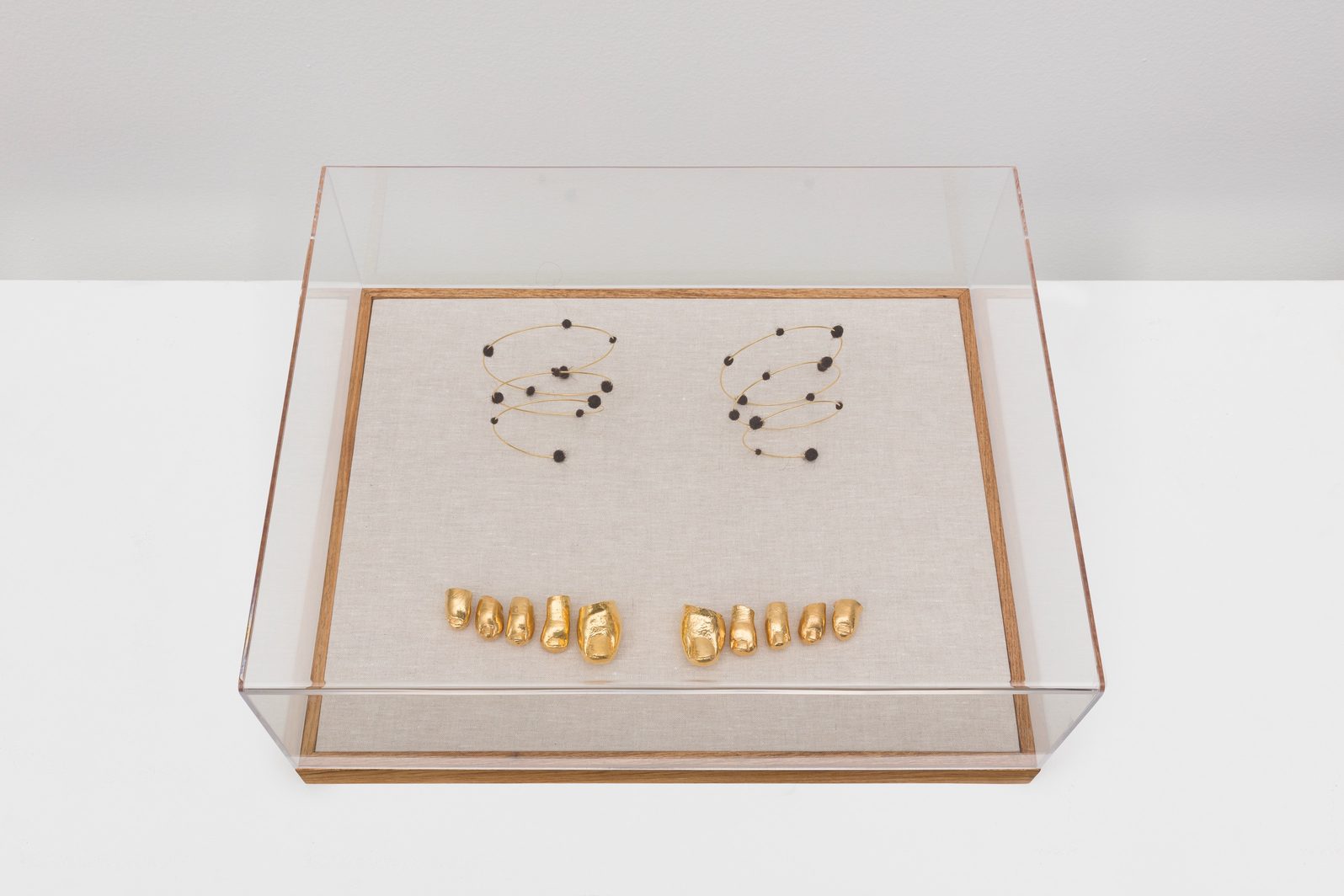
BG: Another work on view at ‘ENERGIA’ in TheMerode is a more sculptural piece, untitled (pedites), from 2023. It consists of resin, copper, and nickel plated in 18-carat gold. What we see are gold castings of toes, your toes, and spirals with little balls of hair, your hair. It all is presented in a well-designed box that recalls the displays in archaeological museums. I can’t help but think of it as a kind of self-portrait of an artist reading themself in terms of self-worth and value.
BB: That is not what I had in mind while making that work but I like your interpretation. The casted toes and hair indeed refer to my DNA. For me, the spirals represent energy and movement across time, a continuity. I am very fascinated by Egyptian archaeology and to this day we keep discovering new things and learning by studying the DNA of preserved bodies. I sometimes imagine, What might future civilisations or future life learn from my DNA? Did you know about the Black pharaohs?
BG: Yes, I saw a riveting documentary about it. Do the references to gold and Egypt have a spiritual layer for you?
BB: There is definitely a spiritual layer. Ancient Egyptians created objects to protect themselves in the afterlife. This work carries my fingerprints as a way of leaving a trace. It is almost like a DNA trace, so I can be recognised in the distant future.
BG: As curators, the presence of your works is important for the way we want to challenge visitors’ expectations and assumptions about Brazil. So often the first images or thoughts that people associate with Brazil relate to ideas about the ‘tropical’ or ‘exotic’. I came to realise that Brazil is gigantic and holds many contradictions within itself. Presenting your pieces and the work of several other artists opens a perspective on the presence and history of Blackness and colonialism. In this way we can start or contribute to conversations about these topics within both the Belgian and Brazilian landscapes. Through Belgium’s colonial history, Africa becomes a point of connection between Belgium and Brazil. The relationship with that continent is very different for both countries though.
BB: That is important. As Brazilians, we have to resist being put into simplistic boxes so often. My work also draws on connections to Egypt, other countries in Africa, the US, Martinique, and Suriname, far beyond Brazilian clichés.
BG: How did growing up in São Paulo shape you?
BB: I grew up in a residential area near Ibirapuera Park. My father and mother met in Rio and then moved to São Paulo. When I was fourteen, my family went bankrupt, and I started working to pay for my studies. That experience changed my perspective and made me more aware of the city’s different faces. Studying at a university in the countryside opened me up even more to Brazil’s diversity. São Paulo is sometimes seen as the ‘money machine’ of Brazil, its inhabitants have a reputation for hard work.
BG: Brazil is also a rich country when it comes to music. What role does music play in your life?
BB: Music was always present at home, thanks to my father. I played instruments, had a band in school, and was surrounded by music at university. Hip hop became important during my school years, especially through artists like Mano Brown, who is one of the members of the Racionais MC’s. Their lyrics address the realities of being Black in Brazil.
BG: Did this music help you connect with your own identity?
BB: Absolutely. Mano Brown’s words helped many people, including myself, recognise and embrace Black identity. His poetry goes beyond direct statements and allows for broader interpretations, something I value in art.
BG: Do you see your work as addressing difference more broadly, beyond race?
BB: My work is made by a Black person, but I also use abstraction so that others can find their own meanings. The flag, for example, is an abstraction. It is open to many readings.
BG: Do you see the meaning of your works changing over time?
BB: Definitely. The significance of a work can evolve as I myself change, and as the context changes. Art should leave room for exchange, for hearing others and yourself.
BG: Those are generous words. Thank you for sharing your experiences, knowledge, and your valuable time and energy.
Bruno Baptistelli is part of the exhibition ‘ENERGIA. Artistic presence in the Belgian-Brazilian landscape’, through 31 March 2026, TheMerode, Brussels, themerode.com
This article was written in the context of the exhibition ENERGIA.